By Regina Holland | National Council for History Education
Download PDF – Spring 2026, Article 4
From 2021 to 2024, The Rural Experience in America: Community Civics through Historical Inquiry project empowered K–12 teachers nationwide to uncover and share stories of change in rural communities. Guided by the themes Regions of Rural America, Rural Lives in Context, and Change and Development, educators explored the diversity and common threads of rural life using the Library of Congress’s vast collections and local historical sources.
Through a three-phase professional learning experience, teachers first completed self-paced online courses focused on analyzing primary sources and exploring the Library’s collections. Next, they participated in expert-led webinars, followed by a collaborative, in-person colloquium where they connected local history to the broader American narrative. At the colloquium, educators partnered with historians, National Council for History Education (NCHE) staff, the Library’s Teaching with Primary Sources (TPS) experts, and rural community leaders to design meaningful public history projects. Together, they examined best practices, crafted unit plans, and received feedback. As teachers implemented these projects with students, they created albums in the TPS Teachers Network and received ongoing support through check-ins and mentorship.

Local Oral History
Public history initiatives such as these illustrate the ways historical inquiry can connect learners to local histories, encourage thoughtful civic engagement, and cultivate enduring practices of critical thinking and lifelong learning. Through place-based research, primary sources, and community narratives, students come to see history as an active process of investigation rather than simply content to be learned. The following examples highlight public history projects that demonstrate how historical inquiry can extend beyond the classroom and contribute to meaningful community engagement.
“Nothing ever happens here!” Bethany Norris, a high school teacher from Thomaston, Georgia, shared this comment she hears frequently from her students when she tells them they are going to learn about their local history. To help students grasp the significance of local history within the broader context, Norris applied what she learned in her Rural Experience professional learning by incorporating LOC.gov resources into her teaching. For example, she used the story of Mary Willingham, a Georgia native featured in this lesson plan about oral history resources to demonstrate how the experiences of ordinary people can provide valuable historical insights. This exploration sparked discussions about unfair wages, working conditions, and racism, and led to broader conversations about Southern history and the Civil Rights Movement.
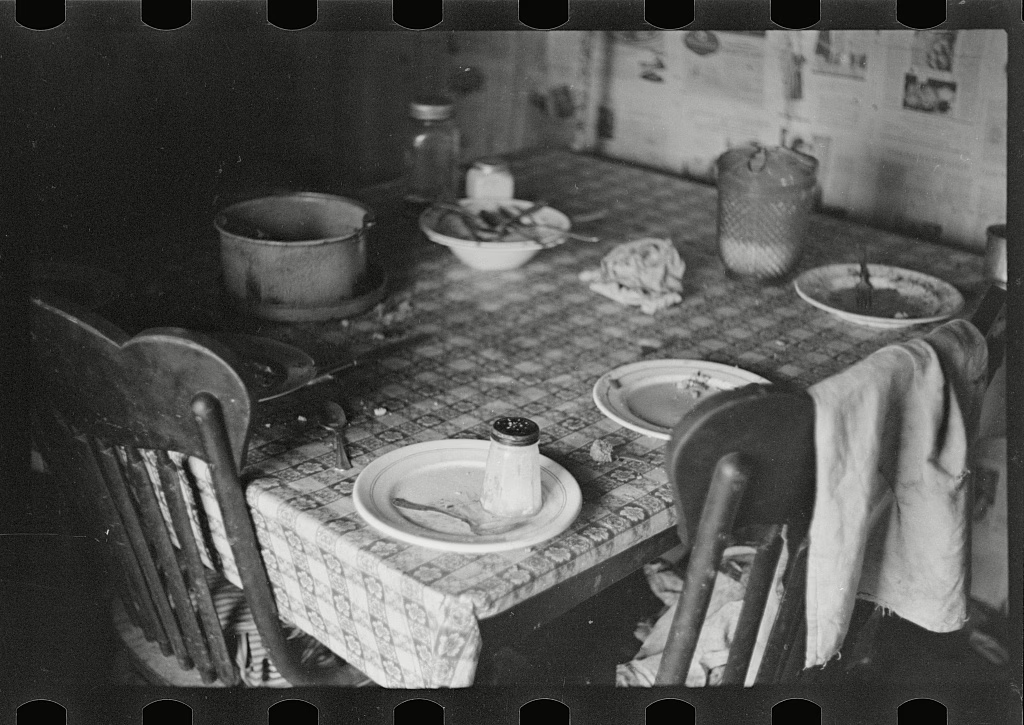
Students then examined additional oral histories, using them as inspiration and models for conducting interviews in their own research projects. Norris also incorporated photographs from the Library’s digital collections, such as the one below, as engaging entry points for exploring local history. She asked students to guess the time and location of the image and make predictions about the person featured in the photograph. This activity led to a discussion about Dorothea Lange and her iconic work documenting the Great Depression. Norris noted, “Many students told me that learning about our history made them realize that rural history matters, and that they gained a greater appreciation for their town.”

Political and Civic Life in Mount Airy
Rebecca Simmons from Mount Airy High School in rural North Carolina collaborated with Olivia Jessup from the Mount Airy Museum of Regional History to launch the public history project, Political and Civic Life in Mount Airy. Simmons’s project aimed to engage students with local history and civic participation through oral interviews and primary source analysis. To spark interest, Simmons used a 1940 Wilmington Morning Star newspaper article titled “Movement to Place N.C. in F.R. Column Started” from the Chronicling America collection to initiate a discussion about how North Carolina political leaders historically influenced national politics. Students later referenced this same article when researching the project’s guiding question, “How has political and civic life in Mount Airy (and Surry County) changed over time, and how has it affected the lives of its citizens?” After researching, students conducted oral history interviews with public service workers in their hometown, county, and state. These interviews helped to open students’ minds to available opportunities, such as the House and Senate Page Program at the North Carolina General Assembly and the Youth Legislative Assembly. Simmons shared, “As a result of this project, my students have become more active members of the community.”
Experiences of Rural Youth
Joe Brewer, a high school teacher from Cuba, Illinois, used a variety of primary sources with his students to show the experiences of rural youth in school, work, on the farm, etc. from the Library’s Child Labor Primary Source Set. For example, he introduced images of youth working in meatpacking factories, since Beardstown, Illinois (his current school location), is home to an international meatpacking plant. He also used images of young workers in mines, as Cuba, Illinois, was once the strip-mining capital of the world. Brewer stated, “I’ve found that these kinds of sources spark a lot of curiosity and help students think more deeply about the past.” He paired these primary sources with the Question Formulation Technique (QFT), a questioning technique from the Right Question Institute that he learned through The Rural Experience project.
Brewer’s students also examined how local buildings and infrastructure in their community have changed over time using Sanborn Fire Insurance Maps. Through a gallery walk, students viewed maps of their rural town from different periods and concluded that their community has always been in flux. Students then engaged in meaningful dialogue with key community leaders about how their town will continue to adapt and make use of this space going forward (e.g., creating murals and spaces for food trucks and music). “Who knew looking at an old insurance map would empower a young person to initiate their own community change?” Brewer shared.
In addition, oral histories were central to Brewer’s project (The Oral History of Forgottonia), and these collections inspired his students to collect their own stories from people in the community. Students spent time listening to narratives, reflecting with peers, and sharing ideas with the class about key people in their community whose stories need to be heard. Students captured these stories by hosting podcasts on various local history topics, including mining, rural school closures, railroads, Native American history, and the Forgottonia movement—a secessionist movement in the late 1960s and early 1970s that took place in 16 counties in western Illinois. In producing these episodes, students practiced civic skills, identified diverse perspectives, and used a combination of technical, creative, and analytical skills that support academic and professional development.
Hands-On Learning with Drones and Aerial Photographs

Ninth- and 10th-grade Michigan STEM students learned how to operate drones to capture a unique, wide-angle perspective of the farms in their community. Operating drones provided these students with a hands-on, interactive, real-life learning experience that boosted engagement, enthusiasm, creativity, collaboration, and civic involvement. Using concepts from their classes in environmental science and United States history, students analyzed photographs of these same farms dating back 100 years that were available at their local museum. Through this analysis, students identified changes in farmland, including land-use patterns, crop rotations, and infrastructure developments. Students finalized their project by creating story maps for the farms using ArcGIS, an online mapping software, and shared their research findings and drone footage with the farmers and their local museum to be included in the historical record. This process fostered a sense of civic responsibility and pride as students engaged in conversations with local farmers and museum staff about the past, present, and future of farming in their community.
By displaying QR codes in prominent locations in their local community, middle school students guided by Kim Sergent and a team of teachers from Hazard, Kentucky, shared their historical research findings by developing a permanent walking tour in Ashland, Kentucky. In addition to blending modern technology with historical preservation, the creation of QR codes required these students to plan, collaborate, and problem-solve. They gathered historical information, determined what information to include, prepared visual and auditory materials, designed the codes, and developed plans for the walking tour. This type of project not only supported student learning and skill development but also reinforced how local government works and the importance of civic duty. Students met with the mayor and city council to seek approval for the proposed project. By engaging with local public officials in this manner, students developed a sense of responsibility toward their community while practicing public speaking and presentation skills. The mayor and city council were so impressed that they publicized the project and its research findings to the community. This project allowed students to leave a legacy in their hometown, as the QR codes are now part of the town’s landscape, educating visitors and residents for years to come. View the video below to hear teachers, community partners, and students reflect on and share their experiences with the project.
Standards-Aligned Local History Resources

Lesson plans and resources are another lasting outcome of this work. Working with preservice teachers, students, and the Maine State Museum, Stephanie Connors from Augusta, Maine, created learning resources for grades K-12 aligned with the Maine Learning Results: Social Studies Standards. In Civics & Government in Maine and Beyond, Mainers who have made a difference in civics and government are showcased, like Samantha Smith, a young Mainer who made a global impact. A sample of the resources made available to teachers and students on the life of Samantha Smith includes the following:
- Carol M. Highsmith’s photograph of the Samantha Smith statue in front of the Maine State Museum in the Library’s digital collections;
- A resolution submitted to the House by John Baldacci proposing that a postage stamp be issued in Smith’s honor; and
- An accompanying Senate Bill by Olympia Snowe proposing postage stamps recognizing young people who made a difference, including Smith.
National History Day (NHD) Extension
National History Day (NHD) offered another valuable extension for these projects. Three of Valencia Abbott’s students at Rockingham Early College High School in Wentworth, North Carolina took their public history project further by creating a senior group documentary entry for the NHD competition. The genesis of their project examined the stories told and untold about the U.S. Supreme Court case Griggs v. Duke Power Co. (1971). They extended this work in their NHD project by examining the global impact of Black World War II veterans on the modern Civil Rights Movement. Through National History Day, these students continued to practice historical thinking skills and build on their learning by making connections to a broader topic in American history.

Implementing a project of this magnitude with students is challenging, but the rewards are substantial. The community-based, service-learning public history projects developed by students in elementary, middle, and high schools across Arkansas, Georgia, Illinois, Kentucky, Maine, Michigan, Missouri, Montana, North Carolina, Ohio, and Oklahoma through The Rural Experience in America project have impacted their communities and beyond. To learn more about the participating teachers, students, community partners, and their projects (including unit plans), visit the NCHE website. Podcast interviews with the participants are also available through RSS Podcasts.
__________
Regina Holland is a TPS Grant Specialist and Program Manager for the National Council for History Education. As a champion for rural educators, she managed the Rural Experience in America: Community Civics through Historical Inquiry TPS project from 2021 to 2024, and currently partners with the Maine Department of Education to support teachers in the State of Maine through the Celebrating Rural Maine: Community Civics and Place-Based Inquiry TPS project. She also serves as a TPS Grant Specialist for the TPS Great Plains Region working with educators, schools, and educational organizations within the Great Plains states of Montana, North Dakota, Oklahoma, South Dakota, and Wyoming. The Maine Department of Education has been a member of the TPS Consortium since 2021, and the National Council for History Education has been a member of the TPS Consortium since 2015.
__________
References
Highsmith, C. M., photographer. (2017) Statue of Samantha Reed Smith on the grounds of the Maine state library, museum, and archives, together in one building in Augusta, the state’s capital city. Maine United States Augusta, 2017. -10-08. [Photograph] Retrieved from the Library of Congress, https://www.loc.gov/item/2017883109/.
Lange, D. (1936, July). Thomaston (vicinity), Georgia. A Georgia tenant farmer who says, “This crop (1936) is nigh to nothin’ as I ever see.” [Photograph]. Library of Congress Prints and Photographs Division. https://www.loc.gov/item/2017768053/