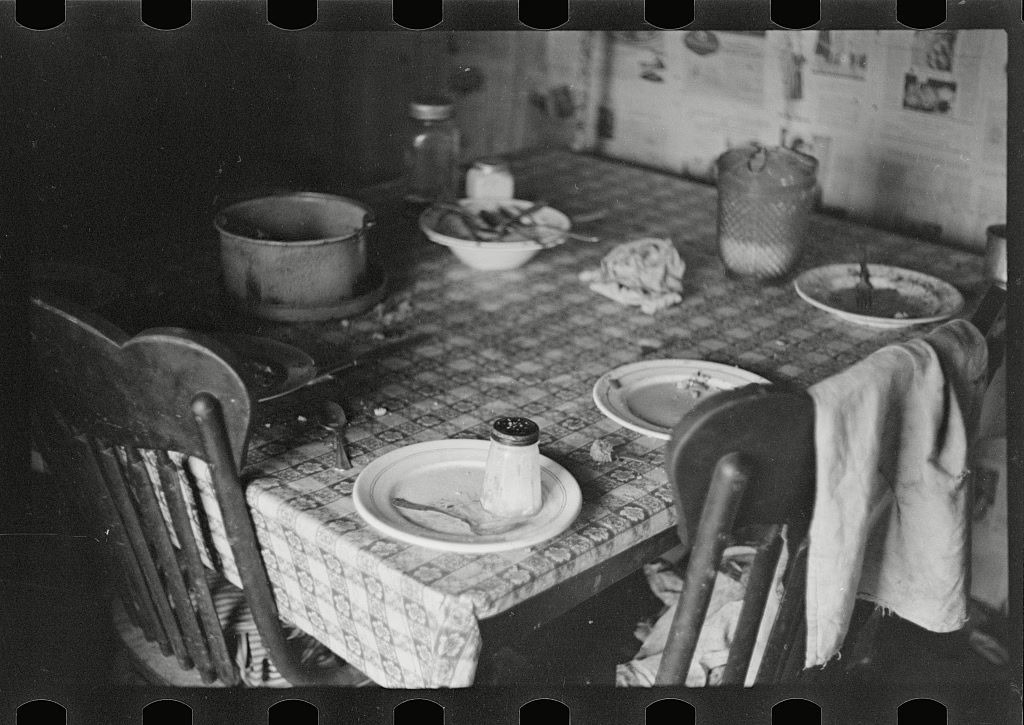
By Rory Dunn (Virginia Commonwealth University)
Download PDF – Spring 2026, Article 1
Introduction
What does it mean to be “rural”? Scholars can’t seem to agree. What is known is that rural spaces in the United States are rapidly changing; the demographic makeup of rural areas is becoming more diverse, and students from immigrant and non-White backgrounds represent a growing proportion of the rural population (Johnson & Lichter, 2022; Lichter, 2012). The most recent federal census information (2020) indicates that young White Americans are moving away from rural spaces to suburban and urban environments at an increasing rate (Johnson & Lichter, 2022). At the same time, other groups are moving to rural areas. This demographic shift coincides with a problem of perception: rural places in the United States are being obscured by stereotypes of rural spaces as non-diverse (Anthony-Stevens & Langford, 2020; Cain & Willis, 2022; Corbett, 2015). As educators, we need to attend to the growing diversity of rural spaces and the lingering assumptions about these places.
In this article I examine the complexity of rural spaces to counteract rural stereotypes in the past and present (Grant, 2022; Wake, 2012; Walker-Gibbs et al., 2018). One way to complicate these stereotypes is through the use of digitized primary sources, accessible through the Library of Congress website, LOC.gov. Incorporating a variety of source material is more reflective of the diversity of rural spaces and experiences. Lastly, I will outline the component parts of the issue written by the Library’s Teaching with Primary Sources (TPS) Consortium members: Regina Holland (National Council of History Education), Dr. Ariel Cornett (Georgia Southern University), Dr. Jaime Beal (Regional School Unit Library Media Specialist), and participants in The Rural Experience in America Project (Angie Albright, Jean Hill, and Melanie G.).
Defining Rurality
When asked how they would consider themselves to be rural, Brooks, an art education major from South Dakota, said, “It depends on what kind of rural area,” and that “rural always seemed like a relative term.” Hayden, a SPED major, realized the non-universality of rural when they said, “I’m not familiar with rural in other places” (Moore & Yoho, 2023, p. 48).
A perpetual problem facing policymakers, scholars, and community members is defining what it means to be rural. In the United States, attempts by the federal government to classify rural and urban locales have extended for over a century (Ratcliffe et al., 2016). These classifications have changed over time; yet, as Ratcliffe et al. (2016) note, there is one consistency: that “the rural definition remains as all territory, persons, and housing units not defined as urban” (p. 2). Outside of the federal government, the field of rural education has spent over 50 years debating what it means to be rural, although there has been little agreement (Grant et al., 2024). These debates have had real consequences in the form of policy decisions (Crain, 2023; Hawley et al., 2016).
Some classify rural places and peoples quantitatively (Koziol et al., 2015) using methods like rural-urban continuum codes (Dunstan et al., 2021). These methods often classify rural spaces using distance from cities and population density, but they do little to discuss the cultural phenomenon of being rural. In fact, Thier et al. (2021) found that in their sample of over 150 studies of rural spaces, “nearly three in five employed a federal schema such as those from [National Council of Education Statistics] NCES, the U.S. Department of Agriculture, or the U.S. Census Bureau” (p. 7).
Federal institutions might be expected to utilize the same standards to classify rural spaces; however, this is not the case. In their study, Crain (2023) noted that “the Center on Rural Innovation identified more than 10 working definitions of rurality employed by federal agencies and rural policy organizations across the [U.S.]” (p. 2). If there is no consensus among experts regarding how to define what is and is not a “rural space,” the question remains: how are rural spaces and students perceived by the public and by educators?
Stereotypes of Rural Spaces
Although there is no single definition of what it means to be rural, scholars have consistently found that rural spaces are portrayed as regressive. People from rural backgrounds are often associated with negative stereotypes, such as the hillbilly, redneck, or “white trash” (Azano & Stewart, 2016; Cain & Willis, 2022; Gallo, 2020; Walker et al., 2018). Popular media has played no small role in perpetuating these stereotypes. For example, media portrayals of rural people as “hillbillies” extend at least as far back as the 1940s. The book The Egg and I, and the film series it inspired, Ma and Pa Kettle, launched cartoonish caricatures of rural White people to the forefront of popular culture in the late 1940s and early 1950s (Massey, 2017).
The image below, sourced from the Library of Congress, provides an earlier example. It depicts the costume design for one of the Federal Theatre Project’s productions, “Machine age,” a musical comedy performed on stage in the late 1930s. The Federal Theater Project was a New Deal program designed to employ struggling artists. The costume design incorporates numerous stereotypical clothing markers, such as overalls, flannel shirts, fake beards, and notably red-neck kerchiefs. In the present, the “white-trash” and “redneck” stereotypes dominate media portrayals of rural spaces (Massey, 2017). These stereotypes are deep-seated, and can be dated as far back as the late 19th-century (Huber, 1995). The use of these stereotypes in the present is problematic because they depict rural people as uncultured, regressive, dim-witted, and homogeneously White.
![[Machine Age: Hillbilly Chorus blue overalls, plaid shirts, red kerchiefs, black hats, and false black beards] https://www.loc.gov/item/musihas.200219068/.](https://tpsconsortiumcreatedmaterials.org/wp-content/uploads/2026/01/iiif-public_music_musihas-200219068_musihas-200219068.0001-full-pct_12.5-0-default.avif)
Federal Theatre Project, U. S. (1934) Machine Age: Hillbilly Chorus blue overalls, plaid shirts, red kerchiefs, black hats, and false black beards. , 1934. [Photograph] Retrieved from the Library of Congress, https://www.loc.gov/item/musihas.200219068/.
Additionally, the popular use of such stereotypes ignores historical examples of resistance and reclamation. For example, the term “redneck,” originally a derogatory term used to describe poor Whites, was utilized by unionizing miners in Appalachia to “foster unity and solidarity amongst racially and ethnically divided miners” (Huber, 2006, p.195). Careless use of these stereotypical rural tropes also obscures the experiences of rural people who do not fit the classification of being poor and White.
Even stereotypes that cast rural spaces and people as assets can have negative effects. Azano and Stewart (2016) found in their work with preservice teachers that their students were likely to describe rural places as being “idyllic.” These students saw rural spaces as simple, intimately connected with nature, community-based, and largely devoid of conflict (Azano & Stewart, 2016; Leyshon, 2008; Pederson & Gram, 2018). When rural spaces are romanticized, the real challenges these communities have faced and continue to face may be overlooked.
In the United States, the stereotype of the rural idyll is as old as the nation itself. Thomas Jefferson was famously obsessed with the yeoman farmer, an almost mythic figure whose relationship to rural land was supposed to be a model for the rest of the nation (Peterson, 1990). The print below by engraver James Trenchard depicts the early American obsession with the yeoman farmer, this enlightened way of life, and its relationship to a moral citizenry. While many rural people may agree with these stereotypes and even reinforce them, romanticizing a mythic rural past obscures the diverse experiences of rural Americans both in the past and in the present (Azano & Stewart, 2016; Fenge et al., 2010).
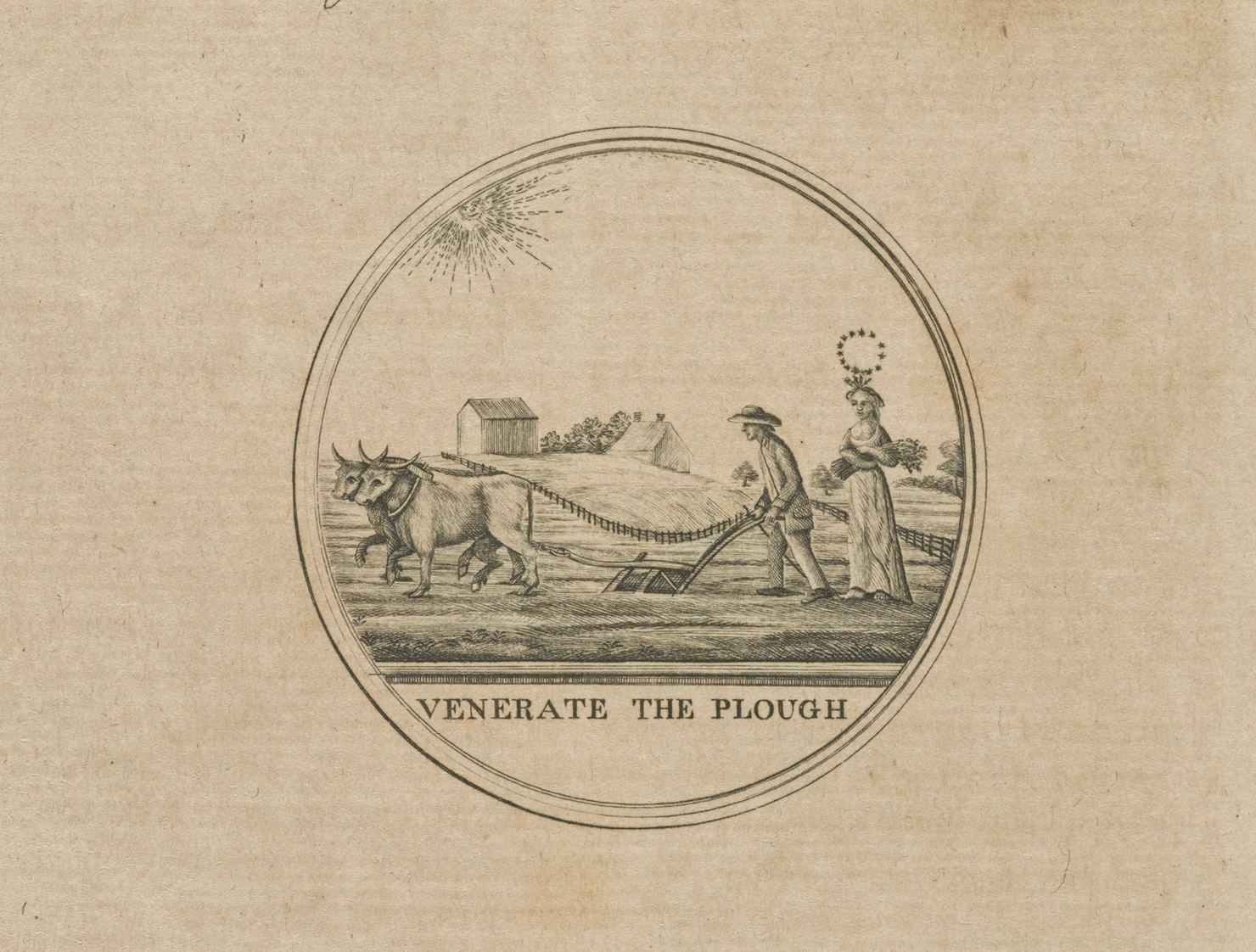
Trenchard, J. (1786) The plan of a farmyard – venerate the plow / J.T. sculp. , 1786. [Photograph] Retrieved from the Library of Congress, https://www.loc.gov/item/2004671570/.
Why should those who serve rural communities think about these historical stereotypes at all? Rural people are acutely aware of these stereotypes and must contend with them in their day-to-day lives. In their study with preservice teachers, Moore and Yoho (2023) found that their “rural participants believ[ed] they were viewed as less than by their non-rural counterparts” (p. 49). Cain and Willis (2022) noted in their study of rural students navigating urban college spaces that one participant “distanced herself from labeling where she was from as rural due to stereotypes she felt were associated with rural people” (p. 79). In their work with preservice teachers from the Midwest, Gallo (2020) found that “the participants … were aware of the stereotypes that characterize communities like theirs, and they used their own narratives to paint a more complete picture of rural life and work” (p. 10).
If rural spaces are examined uncritically through tropes of the past and present, rural students may be alienated from the study of history, identification with a national historical narrative, and civic engagement. Presenting complex and nuanced experiences of past rural people may help disrupt the power of these stereotypes. For example, consider the following image.
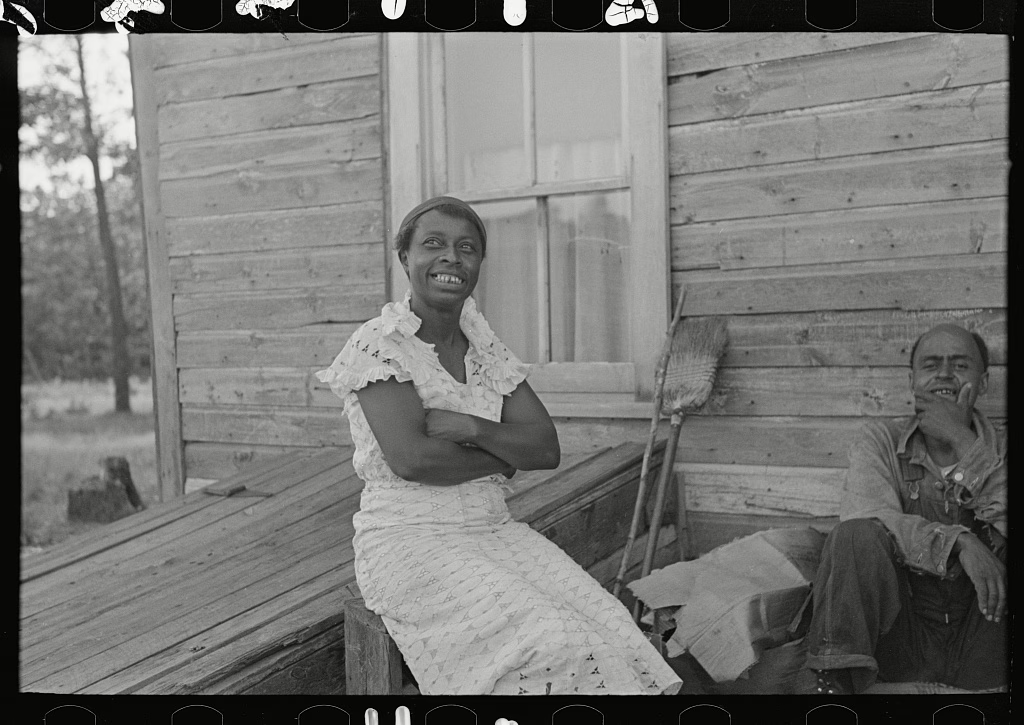
United States Resettlement Administration, Lee, R., photographer. (1937) Mrs. Henry Holt, wife of Negro farmer near Black River Falls, Wisconsin. United States Black River Falls Wisconsin, 1937. June. [Photograph] Retrieved from the Library of Congress, https://www.loc.gov/item/2017735538/.
This photograph captures two people who benefited from the United States Resettlement Administration. The purpose of this New Deal agency was to relocate struggling families from rural and urban areas to communities established by the federal government, many of which were rural. The image reflects hope, rural revitalization, and rural diversity. By integrating images that counteract rural stereotypes, rural spaces can be illuminated as places that have accommodated a diversity of experiences and people—and that continue to do so in the present.
Engaging the Rural Past and Present with Historical Literacy
When students use historians’ methods to study primary source materials, they become more active and engaged, learn historical content and critical thinking skills, and are better prepared to thrive in a democratic society in which easily available information must be vetted (Nokes, 2022, p. 32).
Engaging with primary sources alone is not enough to get students to think critically about the past. Students must also be generative with their knowledge to synthesize understanding of primary sources into historical knowledge—what Nokes (2022) terms historical literacy. The authors of the articles in this issue utilize a combination of historical inquiry and historical literacy practices to help community members engage with complex and nuanced perspectives of rural communities in the United States.
Through historical inquiry strategies such as corroboration, sourcing, and contextualization, students practice the skills of historians as they think historically about the rural past (Wineburg, 1991). Authors in this issue also utilized historical literacy skills such as codebreaking and inferring to prompt students to question assumptions about rural spaces, generate historical knowledge from their thinking, and enact this knowledge in writing (Nokes, 2022). By applying these approaches in local contexts, the authors demonstrate how students, teachers, and museum professionals can work collaboratively to build richer understandings of the rural past, connect these histories to present-day issues, and imagine possibilities for the future.
Complicating Rural Spaces
The authors of the articles included in this issue showcase how TPS Consortium members are working together to question and expand traditional, one-size-fits-all narratives about rural history. The issue outlines (a) how primary sources can be used to complicate the history of rural spaces, (b) how to foster community engagement with local sources and history, and (c) how to build relationships between local teachers, students, and museums in the study of history.
In her article, Dr. Ariel Cornett (Georgia Southern University) focuses on the importance of finding local history connections at the Library of Congress and using students’ personal interests to explore local, state, and national histories in meaningful ways. She utilizes the “Observe, Reflect, Question” analysis tool with Sanborn maps of her hometown (Appalachia, Virginia), and journals and maps of Ossabaw Island (i.e., a rural, Georgia barrier island that she currently partners with to develop curricular resources) to help students understand the past, present, and future of places undergoing preservation and revitalization. Students engaged in a process of observing, reflecting, and questioning to analyze each primary source.
In another article, the authors outline the contributions of the National Council for History Education (NCHE)’s The Rural Experience in America project funded by a grant from the Library of Congress Teaching with Primary Sources program. A participating teacher (Angie Albright), student (Melanie G.), and teacher (Jean Hill) from the project provide insights about place-situated learning in their community.
In a complementary article, Regina Holland (NCHE) further illustrates the immediate and lasting impact of The Rural Experience in America project on participating teachers, students, communities, and beyond. The project (2021-2024) engaged rural teachers in an examination of their local history using an interdisciplinary lens and linked teachers with the Library’s rural collections to situate local narratives in the larger human experience. The project also addressed the professional development gap for rural schools by providing online asynchronous (Part A), online synchronous (Part B), and site-based (Part C) opportunities for teachers. The project supported teachers in the design and implementation of works of public value that connected rural students to their community as lifelong learners.
Lastly, Dr. Jaime Beal (Regional School Unit Library Media Specialist) discusses the launching of the Celebrating Rural Maine project, a joint collaboration between NCHE and the Maine Department of Education. Project goals included merging place-based education and inquiry practices in Maine classrooms and the curation of the Library’s digitized primary sources for teachers.
Conclusion
As Moore and Yoho (2023) explain, “Rural communities are not a monolith” (p.47). Exploring local history helps break down common myths about rural life, both past and present. By using primary sources, students can learn to question stereotypes and gain a more complete picture of rural people and places. This approach not only helps rural students see themselves in history but also provides all students with tools to challenge harmful ideas about rural communities—now and in the future.
__________
Rory Dunn is a Ph.D. Candidate at Virginia Commonwealth University. A former social studies teacher from the rural Northern Neck of Virginia, his research examines the experiences of transplant teachers in rural communities, teaching social studies in rural communities, and the implementation of oral histories in the classroom. He served as one of the Project Education Specialists for the National Council for History Education’s Rural Experience in America: Community Civics through Historical Inquiry TPS project.
__________
References
Anthony-Stevens, V., & Langford, S. (2020). “What do you need a course like that for?” Conceptualizing diverse ruralities in rural teacher education. Journal of Teacher Education, 71(3), 332–344.
Azano, A. P., & Stewart, T. T. (2016). Confronting challenges at the intersection of rurality, place, and teacher preparation: Improving efforts in teacher education to staff rural schools. Global Education Review, 3(1), 108–128.
Cain, E. J., & Willis, J. F. E. (2022). “Does it identify me?”: The multiple identities of college students from rural areas. The Rural Educator, 43(1), 74–87.
Crain, A. M. (2023). Social constructions of rurality: A case study in institutional policy design. Journal of Research in Rural Education, 39(2), 1–18.
Davies, I. (Ed.). (2017). Debates in history teaching (2nd ed.). Routledge.
Dunstan, S., Henderson, M., Griffith, E. H., Jaeger, A., & Zelna, C. (2021). Defining rural: The impact of rural definitions on college student success outcomes. Theory & Practice in Rural Education, 11(1), 60–75.
Federal Theatre Project, U. S. (1934). Machine Age: Hillbilly Chorus blue overalls, plaid shirts, red kerchiefs, black hats, and false black beards [Photograph]. Library of Congress. https://www.loc.gov/item/musihas.200219068/
Fenge, L.-A., Jones, K., & Read, R. (2010). Connecting participatory methods in a study of older lesbian and gay citizens in rural areas. International Journal of Qualitative Methods, 9(4), 320–333.
Gallo, J. (2020). Against the grain: Narratives of rural teachers’ professional lives. The Rural Educator, 41(2), 1–13.
Grant, P. (2022). Whose deficit? Rural student perceptions of secondary curricular opportunities via AP. The High School Journal, 105(4), 294–313.
Hawley, L. R., Koziol, N. A., Bovaird, J. A., McCormick, C. M., Welch, G. W., Arthur, A. M., & Bash, K. (2016). Defining and describing rural: Implications for rural special education research and policy. Rural Special Education Quarterly, 35(3), 3–11.
Huber, P. (1995). A short history of “redneck”: The fashioning of a southern white masculine identity. Southern Cultures, 1(2), 145–166.
Huber, P. (2006). Red necks and red bandanas: Appalachian coal miners and the coloring of union identity, 1912-1936. Western Folklore, 65(1/2), 195–210.
Johnson, K. M., & Lichter, D. T. (2022). Growing racial diversity in rural America: Results from the 2020 census. University of New Hampshire, Carsey School of Public Policy. https://carsey.unh.edu/publication/growing-racial-diversity-in-rural-america.
Koziol, N. A., Arthur, A. M., Hawley, L. R., Bovaird, J. A., Bash, K. L., McCormick, C. M., & Welch, G. W. (2015). Identifying, analyzing, and communicating rural: A quantitative perspective. Journal of Research in Rural Education, 30(4), 1–14.
Leyshon, M. (2008). The betweenness of being a rural youth: Inclusive and exclusive lifestyles. Social & Cultural Geography, 9(1), 1–26.
Lichter, D. T. (2012). Immigration and the new racial diversity in rural America. Rural Sociology, 77(1), 3–35.
Massey, C. (2017). The rhetoric of the real: Stereotypes of rural youth in American reality television and stock photography. Discourse: Studies in the Cultural Politics of Education, 38(3), 365–376.
Moore, J. D., & Yoho, L. M. (2023). There’s land between us: Rurality in the Northern Great Plains. The Rural Educator, 44(2), 44–55.
Nokes, J. D. (2022). Building students’ historical literacies: Learning to read and reason with historical texts and evidence (2nd ed.). Routledge.
Parton, C., & Azano, A. P. (2022). Context matters: Preparing ELA teachers and supporting students in rural areas. English Education, 54(3), 172–176.
Pedersen, H. D., & Gram, M. (2018). “The brainy ones are leaving”: The subtlety of (un)cool places through the eyes of rural youth. Journal of Youth Studies, 21(5), 620–635.
Peterson, T. R. (1990). Jefferson’s yeoman farmer as frontier hero: A self-defeating mythic structure. Agriculture and Human Values, 7(1), 9–19.
Ratcliffe, M., Burd, C., Holder, K., & Fields, A. (2016). Defining rural at the U.S. Census Bureau. American Community Survey and Geography Brief, 1(8), 1–8.
Thier, M., Longhurst, J. M., Grant, P. D., & Hocking, J. E. (2021). Research deserts: A systematic mapping review of U.S. rural education definitions and geographies. Journal of Research in Rural Education, 37(2).
Trenchard, J. (1786). The plan of a farm yard—Venerate the plow [Photograph]. Library of Congress. https://www.loc.gov/item/2004671570/
United States Resettlement Administration. (1937). Mrs. Henry Holt, wife of Negro farmer near Black River Falls, Wisconsin. United States Black River Falls Wisconsin [Photograph]. Library of Congress, https://www.loc.gov/item/2017735538/
Wake, D. G. (2012). Exploring rural contexts with digital storytelling. The Rural Educator, 33(3), 23–37.
Walker-Gibbs, B., Ludecke, M., & Kline, J. (2018). Pedagogy of the rural as a lens for understanding beginning teachers’ identity and positionings in rural schools. Pedagogy, Culture, & Society, 26(2), 301–314.