By Jaime Beal, Ed.D. (Regional School Unit 40, Maine)
Download PDF – Spring 2026, Article 5
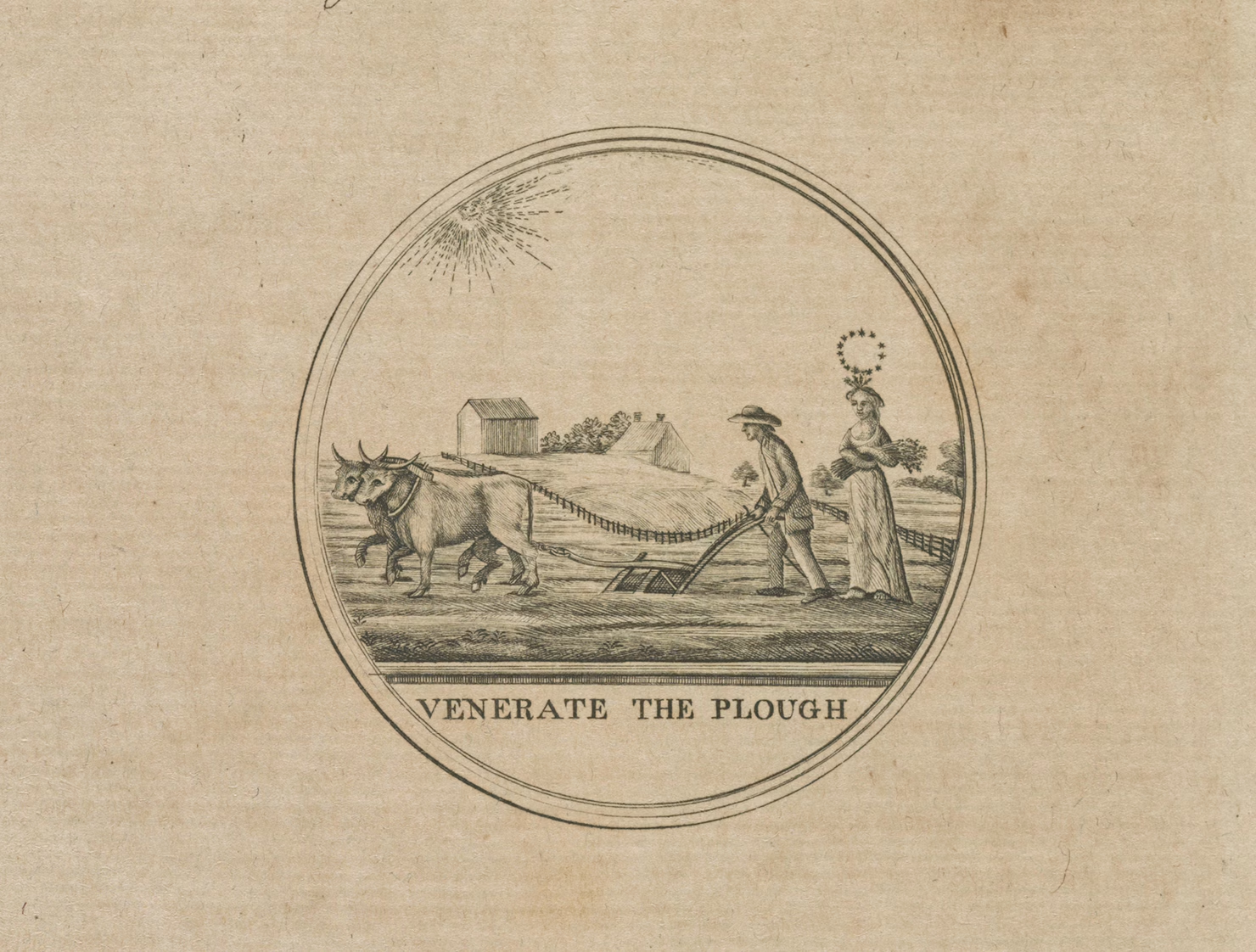
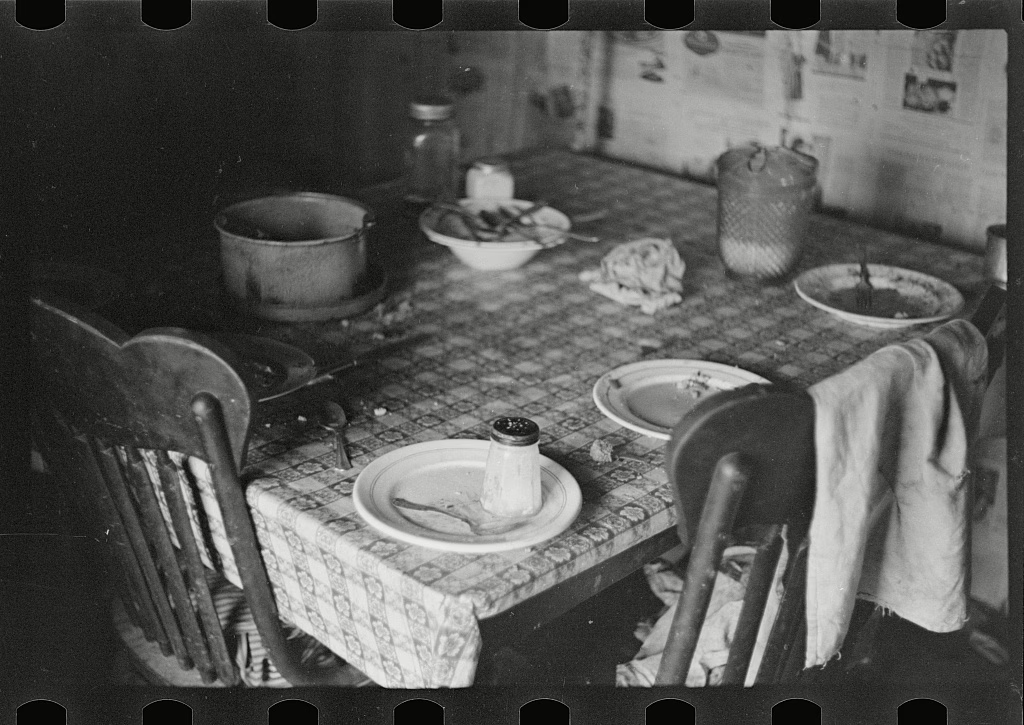
The National Council for History Education (NCHE) successfully led The Rural Experience in America project for three years funded by the Library of Congress Teaching with Primary Sources (TPS) program. As that work concluded, the Maine Department of Education (Maine DOE) began collaborating with NCHE. The result is Celebrating Rural Maine: Community Civics and Place-Based Inquiry, another TPS-funded project that builds on the content and structure of The Rural Experience in America while integrating the Maine DOE’s focus on interdisciplinary instruction and leveraging the Library of Congress’s rich digital collections of resources available through LOC.gov.
In this article I outline the process of aligning the visions and efforts of the Maine DOE and NCHE to create this innovative program. The goal is to show how the Maine DOE and NCHE created a partnership to deliver a program that can serve as an example for other organizations and states embarking on similar projects.
Guiding Questions
As the organizations collaborated to combine content and process, we developed the following guiding questions:
- What makes The Rural Experience in America project unique and successful?
- How does the vision and work of the Maine DOE connect with The Rural Experience in America?
- What parts of the Library’s digital collections and TPS professional development support our collaborative work?
- What lessons have we learned that could benefit other states and organizations working on similar projects?
Focus on Rural, Place-Based Education
What makes The Rural Experience in America project unique and successful?
The Maine DOE was drawn to The Rural Experience in America project for its focus on rural, place-based education, which aligned with the Maine DOE’s interdisciplinary approaches. This project ensures that all students have access to expert teachers who connect learning to their communities’ histories. With 68% of Maine schools classified as rural, serving one-third of the state’s students (Showalter et al., 2023), implementing a similar initiative in Maine could have a significant impact. As one Maine teacher participating in The Rural Experience said:
The Rural Experience program was more than I expected. It opened my eyes to the connection that all of us have to rural America. I enjoyed meeting and learning with educators from across the U.S.; the notion that we have more in common than not was reinforced for me. This is a program that I would highly recommend to any educator looking to expand their instructional practice into place-based education and connecting learners to their communities.
The Maine DOE wanted to extend these experiences with the Celebrating Rural Maine project.
High-quality professional development includes content focus, active learning, coherence, duration, and collective participation (Desimone, 2009), all of which enhance professional knowledge, influence beliefs, change practices, and improve student learning. The Rural Experience in America project incorporated these features while ensuring accessibility for rural teachers through virtual and in-person options, both synchronous and asynchronous. Depending on their level of involvement, educators engaged with the program for several months, with some participating for up to three years.
The Celebrating Rural Maine project retained the three-part structure of The Rural Experience project while tailoring content to fit Maine DOE mandates and initiatives. Part A featured asynchronous courses on the Maine DOE platform including the Library’s TPS content and the Right Question Institute’s Question Formulation Technique, which focuses on quality primary source instruction, inquiry strategies, and interdisciplinary instruction. The program included three after-hours synchronous sessions tailored to Maine DOE’s goals: Wabanaki intellectual property, rural representation in primary sources, and exploring the Library’s interdisciplinary resources. As a new program feature, teachers created background knowledge placemats, which combined primary sources with texts, graphics, and more to support literacy and content integration. These placemats, housed on the Maine DOE and NCHE websites, served as resources for other educators and demonstrate teachers’ learning.
The Maine DOE has a Wabanaki Studies Specialist and advisory committee working on several projects to meaningfully integrate Wabanaki studies throughout its work. Due to continuing professional learning provided to Maine DOE staff, the decision was made to organize Part B chronologically rather than thematically to better honor the Wabanaki people’s 12,000-year presence in the place we now call Maine. By reorganizing, the program shows the Wabanaki people throughout the entire span of this history. For example, the first colloquium focuses entirely on the Wabanaki people. The second and third colloquia include both Wabanaki and colonial settler perspectives on geography.
Part C launched with a summer institute in which teachers and community partners collaborated with experts to design civic, place-based projects for implementation in fall 2025. This component was designed to showcase the professional learning offered by the project by supporting teachers in designing meaningful projects that engage students in high-quality instruction while connecting with their communities. Teachers received stipends for time and materials, along with coaching from Maine DOE and NCHE staff. Finalized unit plans and resources were featured on Maine DOE and NCHE sites as exemplars for Maine’s interdisciplinary initiatives. Each project will also be showcased in a podcast, mirroring the approach of The Rural Experience project.
Maine DOE’s Vision
How does the vision and work of the Maine DOE connect with The Rural Experience in America?
Effective professional development meets educators where they are. In an education system with increasingly siloed content areas, however, students often report feeling disconnected from their learning. Interdisciplinary approaches, such as place-based and inquiry-based instruction, can help bridge the gap between classroom learning and students’ lived experiences by providing authentic, relevant purposes for learning content (Learning Policy Institute & Turnaround for Children, 2021). Balancing disciplinary knowledge while supporting interdisciplinary approaches is essential, especially in contexts with strong local control.
At its core, the Maine DOE Interdisciplinary Instruction team defined interdisciplinary instruction as bridging different content areas while maintaining the integrity of each. A common example is using the writing process in social studies instruction. When interdisciplinary pedagogies are embraced, educators can foster a more holistic and authentic approach to learning. This approach empowers the next generation of leaders to think critically, collaborate across disciplines, and innovate solutions to interconnected social, economic, and environmental challenges.
The Celebrating Rural Maine team developed a framework that honors both disciplinary and interdisciplinary models of instruction based on concept-based instruction (Erickson & Lanning, 2014; Stern, Ferraro, Duncan, & Aleo, 2021). This interdisciplinary framework provides actionable guidance for educators shifting from disciplinary to interdisciplinary instruction in a clear, visible way. By designing lessons with these elements, students develop conceptual understandings through real-world applications. When students share their learning about issues that matter to them, they also develop enduring skills such as collaboration and teamwork. The interdisciplinary instruction team uses this framework to guide the professional learning opportunities it develops.

Figure 2 Interdisciplinary Framework (From the Maine DOE, n.d.)
NCHE’s The Rural Experience in America project dovetailed beautifully with the Maine DOE’s interdisciplinary framework. Grounded in history and using place-based inquiry approaches, the project supported teachers in developing interdisciplinary projects that engaged students and communities. Past projects incorporated tools such as drones to map farms, as well as technology and art. Recognizing that partnerships are essential for working at scale, the Maine DOE saw strong potential in bringing such a program to PK-12 teachers across the state.
The framework that NCHE used in The Rural Experience in America project aligned closely with Maine’s educational mandates and the Maine DOE’s initiatives. Therefore, the Maine DOE retained that framework by using the themes of geography, climate, and people to support Maine mandates related to Wabanaki and initiatives focused on interdisciplinary instruction.
Primary Source Integration
How does the Celebrating Rural Maine project incorporate Library of Congress primary sources and TPS professional development resources?
While primary sources are often associated with social studies, the Library’s collections offer rich interdisciplinary connections to primary sources in a variety of formats, including maps, images, music, film, scientific journals, and art. These resources are highlighted throughout the project. For example, interdisciplinary primary sources are embedded throughout the TPS Eastern Region’s TPS Basics course featured in Part A of the project. The TPS Basics course introduces how to navigate the Library’s website and get started with primary sources in K-12 teaching.
The Celebrating Rural Maine team adapted the TPS Basics course content to highlight rural areas whenever possible. For example, the original TPS Basics course includes, “Hide and Seek on Mulberry Street,” an activity in which teachers use a historical image of an urban area for students to play the hide-and-seek game, where someone seeks a detail hiding within this source. The team kept the activity but replaced its urban image with one depicting a rural Maine area.

Image of View of Oldtown, on the Penobscot River, Maine used in the Hide-and-Seek activity. https://www.loc.gov/resource/ds.14356
Another adapted TPS Basic course activity focused on pairing picture books with primary sources. Recently, the Maine DOE began the Pine Project, a collection of thirty picture books highlighting the experiences of immigrant families to all Maine school districts as well as professional development to support using the books. The Celebrating Rural Maine team revised the TPS Basics activity by pairing picture books with primary sources that complement the Pine Project books. For example, the below image was paired with a Pine Project book about Haitian immigrants to help build students’ background knowledge about a place. The overall activity encourages teachers to use both primary sources and the Pine Project collection of books with their students.

Portrait of Toussaint L’Ouverture, a leader in the Haitian Revolution. https://www.loc.gov/item/2014645197
Additionally, the TPS Teachers Network, a platform where teachers share primary source lesson ideas, will allow us to develop a collection of interdisciplinary primary sources. Participating teachers can share their primary sources and lesson plans through the album feature, TPS Maine group, and inquiry starter sets. One of the requirements of our project is that participating teachers develop resources to share. By crowd-sourcing resources in places like the TPS Teachers Network, we will be able to expand access to resources to support Wabanaki studies, African American studies, and the history of genocide including the Holocaust mandates. In this way, the project leaves an enduring presence for Maine teachers.
Reflecting on Maine DOE and NCHE Collaboration
What lessons learned from the Maine DOE and NCHE collaboration could benefit other states and organizations working on similar projects?
Because each organization has distinct goals, starting early was essential for alignment during the grant proposal writing process and included regularly scheduled meetings to ensure time for navigating mandates and ideas. The final program reflected both organizations’ priorities. For example, the project focused on Wabanaki studies to meet the Maine DOE’s mandate, while introducing a history education focus aligns with NCHE’s mission.
A key factor in the partnership’s success was a shared commitment to each organization’s work. While promoting interdisciplinary learning, one partner ensured history remained central, while the other supported connecting history to additional content areas. For example, several presenters used primary sources in science to connect with social studies. The collaboration itself modeled effective interdisciplinary approaches to professional development.
By combining resources, the organizational partners expanded their recruitment reach through local and national networks. This approach helped connect with Maine educators, bring in external presenters, and spark interest from other states. Feedback from teachers and organizations across the country indicates demand for this type of professional development. Through Celebrating Rural Maine and related projects, both organizations strive to create support systems that nurture educators and their communities by bringing them together and providing with high-quality professional development.
__________
Jaime Beal, EdD, is a Library Media Specialist with Regional School Unit 40 in rural Maine. A former elementary teacher, she previously served as an Interdisciplinary Instruction Specialist at the Maine Department of Education, where she worked on the Celebrating Rural Maine: Community Civics and Place-Based Inquiry TPS project in collaboration with the National Council for History Education. She currently focuses on integrating primary sources and interdisciplinary practices across seven rural school libraries.
__________
References
Desimone, L. M. (2009). Improving impact studies of teachers’ professional development: Toward better conceptualizations and measures. Educational Researcher, 38(3), 181–199. https://doi.org/10.3102/0013189X08331140
Erickson, H. L., & Lanning, L. A. (2014). Transitioning to concept-based curriculum and instruction: How to bring content and process together. Corwin.
Learning Policy Institute, & Turnaround for Children. (2021). Design principles for schools: Putting the science of learning and development into action. https://k12.designprinciples.org/
Stern, J., Ferraro, K., Duncan, K., & Aleo, T. (2021). Learning that transfers: Designing curriculum for a changing world. Corwin.