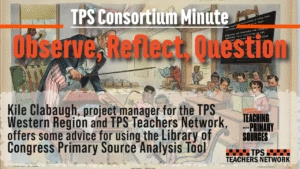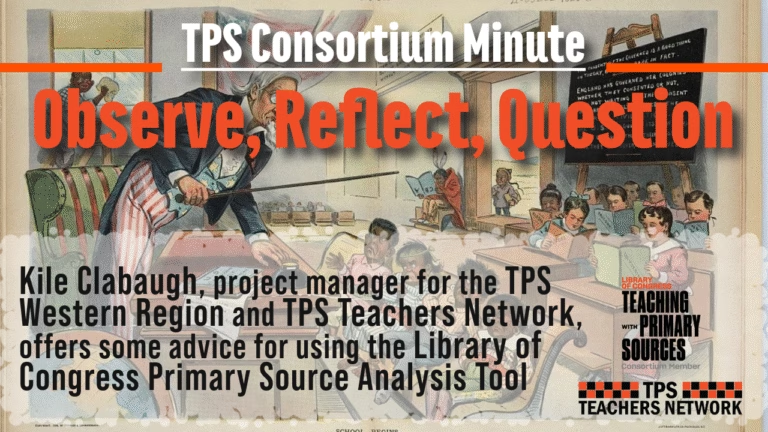
Learn how Kile Clabaugh, project manager for the TPS Western Region and TPS Teachers Network, uses the Primary Source Analysis Tool from the Library of Congress to analyze a political cartoon.
PS Analysis Tool: loc.gov/programs/teachers/getting-started-with-primary-sources/guides
Transcript
This primary source is called School Begins, and it’s one of those primary sources that hits a ton of different subject areas taught in nearly every middle to high school social studies or history course. The political cartoon is from Puck, which is a well-known satis magazine that covered topics from American society from 1876 all the way up until 1918. In fact, the entire Puck collection is available digitally at the Library of Congress website and it contains fodder for nearly every culturally relevant topic of the time.
I like to use this as an initial introduction to the Library of Congress’s Primary Source Analysis Tool. The Observe, Reflect, Question process really forces students to compartmentalize their thinking so they don’t jump to conclusions, and instead make inferences from actual empirical evidence. The Observe, Reflect, Question is simple but it can be adapted and level for any learner. For example, the vocabulary of the analysis tool could be leveled for younger learners to See, Think, Wonder instead of Observe, Reflect, Question. This can also be done as a whole group, small group or individually. As a teacher, really guiding students through the process and keeping them on track is key.
The first step in the analysis process is to hand out copies of the image or display it so that everybody can clearly see it. After you let students view the image for a few minutes, ask them what they observe or see in the image. In the Observe step, students should only be making observations without any inferences. In other words, they shouldn’t think about what’s going on. They should only be taking inventory of specific things in the image that could potentially be clues to making those inferences. As students make observations, you can point to them so everyone can see and or write those observations down.
After a good collection of observations are recorded, ask the students what inferences they can make about the image. What do they think is going on? When do they think the image was created? Why do they think it was created? Observations that were made before are often used as evidence for making claims now in the Reflect stage.
The next step is to create questions. The Reflect and Question steps are often intertwined in that some inferences that we make lead to further questions. Still, it’s important to separate students’ thinking when they’re making inferences and when they’re asking questions.
After the above is completed, a group discussion about the image often happens uh to help fill in any information about the image that wasn’t already expressed. This is a good time to bring in background information that you know that the students weren’t able to bring out in the image or anything else you’d like to bring into your lesson.
This source is great for analysis because it contains an incredible amount of references to significant events in US history. This specific image, School Begins, contains references to imperialism, slavery, Chinese Exclusion, Native American assimilation, Spanish American War, Roosevelt, and really so much more. Additionally, when this is done as a whole group exercise, the power of the primary source analysis tool is in the knowledge exchange from student to student. One student may know a reference while another student may not, and being able to share their own background knowledge on any given topic allows students to take control of their own learning for the benefit of others.
This primary source and the primary source analysis tool work great as a foundational strategy to analyze primary sources. The School Begins image in particular really brings about a slew of discussions where every student has a chance to share their own perspective and give their own viewpoint on what they think is happening.
Students who engage in this inquiry process really realize how it can be applied to any context whether historical or current. A good extension activity with the primary source analysis tool is to have students find culturally significant images in their own lives, like memes and comics or things like that, and then have them conduct a primary source analysis on the chosen image. That can really help to show them the power of that compartmentalization.
Contextual information about School Begins can be found here.